A real black hole
Cygnus X-1
A black hole feeding on the wind of a giant star, seen in two states.
A black hole of about 21 Suns, 7 200 light years away, feeding on the wind of a giant star it orbits. It switches between two states. In one, which astronomers call the hard state, it is wrapped in a hot cloud and throws out a jet. In the other, the soft state, a bright, thin disc forms and the jet fades.
How we draw it today
These are stills from the program that draws every black hole on BlackHoles.fyi, worked out from what astronomers have measured about Cygnus X-1: its mass and, where they are known, its spin and how fast it feeds. The site is open to a small group of testers while we finish it; signed in, they see these same views drawn live and can move between them.
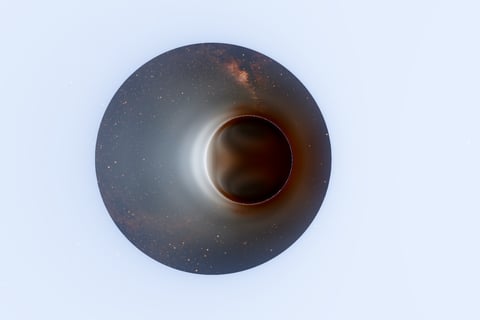
Side on 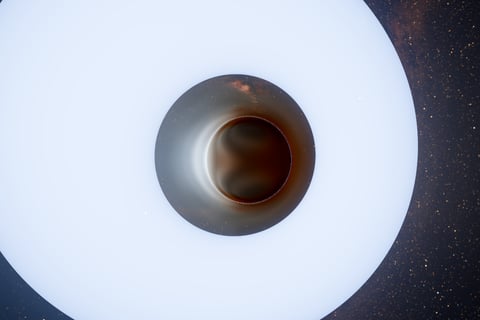
Low angle 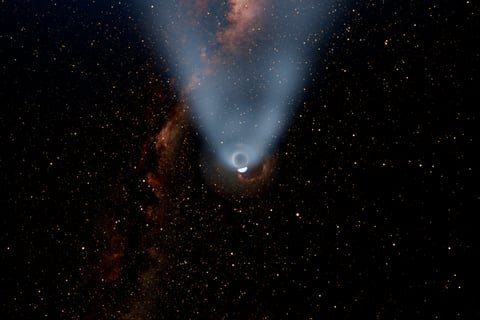
From above 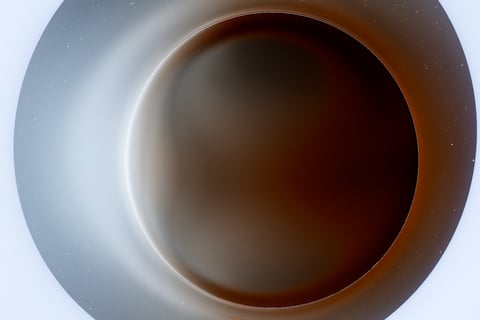
Close 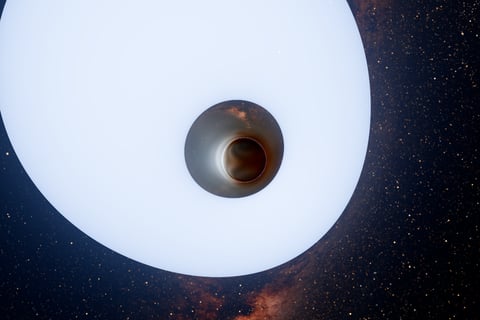
Far 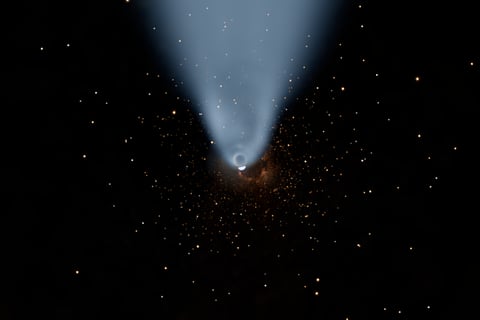
As seen from Earth 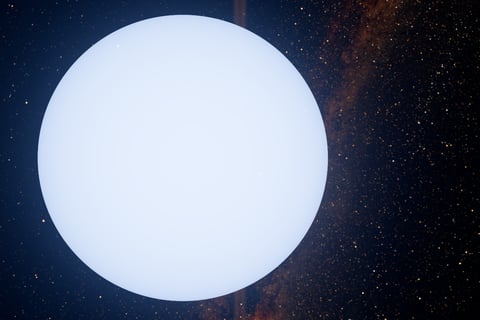
Jet 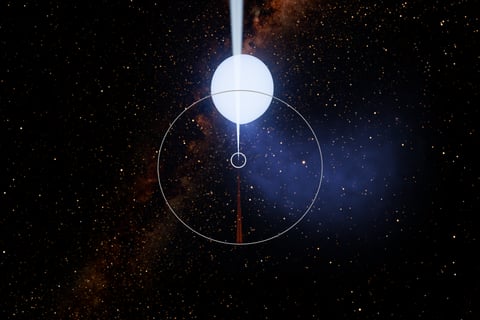
The whole system 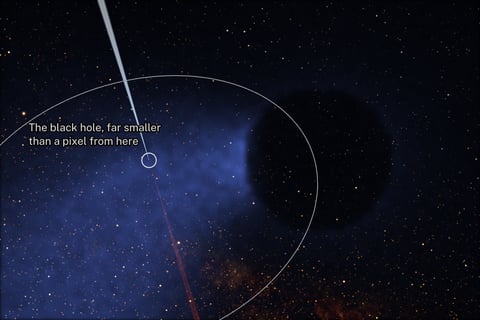
Between companion star and hole
Drawn live, it can also be turned, and you can change how fast it spins and feeds.
Sign in if you have an invite code, or join the waitlist.
Where the numbers come from
There is no catalogue of black holes as such, as far as we know. A hole goes by the name of something we can see: the star orbiting it, the X-ray source, the galaxy around it. When two black holes merge into one, the new hole is named for the date the ripple in space from the merger (its gravitational waves) reached the detectors on Earth that listen for them. SIMBAD is astronomers' online catalogue of objects beyond the Solar System. Known as: in SIMBAD, HD 226868 (the companion star's name, which SIMBAD uses for the pair), X Cyg X-1, V1357 Cyg and Gaia DR3 2059383668236814720.
- Mass, in M☉ (the Sun's mass): 21.2 ± 2.2 M☉, from the companion star's orbit, with the distance from the radio parallax. J. C. A. Miller-Jones et al., “Cygnus X-1 contains a 21-solar mass black hole: implications for massive star winds”, Science 371, 1046 (2021), Table 1. doi:10.1126/science.abb3363, arXiv:2102.09091
- Spin, a* (0 is still, 1 is the fastest a hole can turn): > 0.9985, from fitting the disc's X-ray glow (continuum fitting), with the 2021 mass, tilt and distance, at 3σ. X. Zhao et al., “Re-estimating the Spin Parameter of the Black Hole in Cygnus X-1”, The Astrophysical Journal (2021). doi:10.3847/1538-4357/abbcd6, arXiv:2102.09093
- Spin: > 0.9981, from continuum fitting of AstroSat spectra in its softest state, at 3σ. A. Kushwaha, K. Agrawal and A. Nandi, “AstroSat and MAXI view of Cygnus X-1: Signature of an ‘extreme’ soft nature”, Monthly Notices of the Royal Astronomical Society (2021). doi:10.1093/mnras/stab2258, arXiv:2108.01130
- Spin: > 0.95, from continuum fitting with the older mass of 14.8 Suns, at 3σ. L. Gou et al., “The Extreme Spin of the Black Hole in Cygnus X-1”, The Astrophysical Journal 742, 85 (2011). doi:10.1088/0004-637X/742/2/85, arXiv:1106.3690
- Spin: > 0.83, from the shape of the iron line in its X-ray light (reflection), from NuSTAR and Suzaku in the soft state. J. A. Tomsick et al., “The Reflection Component from Cygnus X-1 in the Soft State Measured by NuSTAR and Suzaku”, The Astrophysical Journal 780, 78 (2014). doi:10.1088/0004-637X/780/1/78, arXiv:1310.3830
- Spin: 0.950 +0.04/−0.084, from reflection, refitting every NuSTAR observation. P. A. Draghis et al., “Systematically Revisiting All NuSTAR Spins of Black Holes in X-Ray Binaries”, The Astrophysical Journal 969, 40 (2024). doi:10.3847/1538-4357/ad43ea, arXiv:2311.16225
- Spin: 0.87 +0.04/−0.03, from continuum fitting and reflection together, with the disc's tilt left free. A. A. Zdziarski et al., “What Is the Black Hole Spin in Cyg X-1?”, The Astrophysical Journal Letters (2024). arXiv:2402.12325
- Spin: 0.90 ± 0.01, from the same fit with the disc's tilt held at the orbit's 27.5°. A. A. Zdziarski et al., “What Is the Black Hole Spin in Cyg X-1?”, The Astrophysical Journal Letters (2024). arXiv:2402.12325
- Spin: < 0.1, from the same fit with a warm layer of gas covering the disc. A. A. Zdziarski et al., “What Is the Black Hole Spin in Cyg X-1?”, The Astrophysical Journal Letters (2024). arXiv:2402.12325
- Spin: 0.98, from reflection, from the iron line seen by XRISM; the paper gives about 0.98. P. A. Draghis et al., “A XRISM View of Relativistic Reflection in Cygnus X-1” (2025), preprint. arXiv:2511.17338
- Spin: < 0.17 (0.0 +0.17 with one reflection model and 0.99 with another; with all the data together, any spin fits), from reflection, from XRISM, comparing models. Where a spin has several published values, each one is listed with its method. The picture is drawn at the middle of the range of published values. A. A. Zdziarski et al., “Model dependence of XRISM black-hole spin constraints in Cyg X-1” (2026), preprint. arXiv:2605.24664
- Spin drawn: 0.499, the middle of the range of published values (spin assumed).
- Feed: < 0.014 (from 0.3% to about 1.4% of the Eddington rate across its states), from AstroSat X-ray spectra from 2016 to 2019, over its Eddington luminosity, 2.8 × 10³⁹ erg/s. A. Kushwaha, K. Agrawal and A. Nandi, “AstroSat and MAXI view of Cygnus X-1: Signature of an ‘extreme’ soft nature”, Monthly Notices of the Royal Astronomical Society (2021). doi:10.1093/mnras/stab2258, arXiv:2108.01130
- Hard state, feed: 3 × 10⁻³, from AstroSat X-ray light in the hard state, 2016, over its Eddington luminosity, 2.8 × 10³⁹ erg/s: the low end of the range the paper gives across its states. A. Kushwaha, K. Agrawal and A. Nandi, “AstroSat and MAXI view of Cygnus X-1: Signature of an ‘extreme’ soft nature”, Monthly Notices of the Royal Astronomical Society (2021). doi:10.1093/mnras/stab2258, arXiv:2108.01130
- Soft state, feed: 0.014, from AstroSat X-ray light from the disc in the soft state, October 2017, over its Eddington luminosity, 2.8 × 10³⁹ erg/s. A. Kushwaha, K. Agrawal and A. Nandi, “AstroSat and MAXI view of Cygnus X-1: Signature of an ‘extreme’ soft nature”, Monthly Notices of the Royal Astronomical Society (2021). doi:10.1093/mnras/stab2258, arXiv:2108.01130
- Angle: 27.51 +0.77/−0.57°, from the tilt of the star's orbit; X-ray studies put the inner disc at 39° to 63°, and they do not yet agree with one another. J. C. A. Miller-Jones et al., “Cygnus X-1 contains a 21-solar mass black hole: implications for massive star winds”, Science 371, 1046 (2021), Table 1. doi:10.1126/science.abb3363, arXiv:2102.09091 and A. A. Zdziarski et al., “What Is the Black Hole Spin in Cyg X-1?”, The Astrophysical Journal Letters (2024). arXiv:2402.12325 and P. A. Draghis et al., “Systematically Revisiting All NuSTAR Spins of Black Holes in X-Ray Binaries”, The Astrophysical Journal 969, 40 (2024). doi:10.3847/1538-4357/ad43ea, arXiv:2311.16225
- Distance: 7 241 +587/−554 light years (2.22 +0.18/−0.17 kpc, kiloparsecs, each a thousand parsecs of 3.26 light years), from radio parallax. J. C. A. Miller-Jones et al., “Cygnus X-1 contains a 21-solar mass black hole: implications for massive star winds”, Science 371, 1046 (2021), Table 1. doi:10.1126/science.abb3363, arXiv:2102.09091
- Its tilt on our sky: 152.9 ± 0.7°, from the hole's orbit tracked on the sky by radio (VLBA); over 90° means the star goes round clockwise as we see it. J. C. A. Miller-Jones et al., “Cygnus X-1 contains a 21-solar mass black hole: implications for massive star winds”, Science 371, 1046 (2021), Supplementary Table S3. doi:10.1126/science.abb3363, arXiv:2102.09091
- The companion star's orbit, once round: 5.599829 ± 0.000016 days, from the timing of the star's light curve (the photometric ephemeris). C. Brocksopp, A. E. Tarasov, V. M. Lyuty and P. Roche, “An Improved Orbital Ephemeris for Cygnus X-1”, Astronomy & Astrophysics 343, 861 (1999). arXiv:astro-ph/9812077
- Its distance from the hole, halfway between nearest and farthest: 0.244 +0.012/−0.013 au, from the model fitted to the star's light and velocity curves. J. C. A. Miller-Jones et al., “Cygnus X-1 contains a 21-solar mass black hole: implications for massive star winds”, Science 371, 1046 (2021), Table 1. doi:10.1126/science.abb3363, arXiv:2102.09091
- Its eccentricity (0 is a circle): 0.0189 +0.0028/−0.0026, from the model fitted to the star's light and velocity curves. J. C. A. Miller-Jones et al., “Cygnus X-1 contains a 21-solar mass black hole: implications for massive star winds”, Science 371, 1046 (2021), Table 1. doi:10.1126/science.abb3363, arXiv:2102.09091
- How it lies on our sky: its rising node 64.1 ± 1.0° east of north, from the radio fit (assumed: the fit takes the jet to lie along the orbit's axis, and the radio data alone give 95 ± 18°); its nearest point 305 ± 5° on from that, from the radio fit's 125 ± 5° for the hole, plus 180°, since the star is always on the opposite side of their shared centre; reached on 31 July 1971, from the 1971 conjunction, hole behind the star, plus the 0.109 of a period that periastron follows it by. J. C. A. Miller-Jones et al., “Cygnus X-1 contains a 21-solar mass black hole: implications for massive star winds”, Science 371, 1046 (2021), Supplementary Table S3. doi:10.1126/science.abb3363, arXiv:2102.09091 and C. Brocksopp, A. E. Tarasov, V. M. Lyuty and P. Roche, “An Improved Orbital Ephemeris for Cygnus X-1”, Astronomy & Astrophysics 343, 861 (1999). arXiv:astro-ph/9812077 and J. C. A. Miller-Jones et al., “Cygnus X-1 contains a 21-solar mass black hole: implications for massive star winds”, Science 371, 1046 (2021), Table 1. doi:10.1126/science.abb3363, arXiv:2102.09091
- The companion star's mass: 40.6 +7.7/−7.1 M☉, from the model fitted to the star's light and velocity curves. J. C. A. Miller-Jones et al., “Cygnus X-1 contains a 21-solar mass black hole: implications for massive star winds”, Science 371, 1046 (2021), Table 1. doi:10.1126/science.abb3363, arXiv:2102.09091
- The companion star's radius: 22.3 +1.8/−1.7 solar radii, from the model fitted to the star's light and velocity curves. J. C. A. Miller-Jones et al., “Cygnus X-1 contains a 21-solar mass black hole: implications for massive star winds”, Science 371, 1046 (2021), Table 1. doi:10.1126/science.abb3363, arXiv:2102.09091
- How far the companion star reaches towards the point where the hole's pull takes over: 0.960 +0.028/−0.03, from the model fitted to the star's light and velocity curves. J. C. A. Miller-Jones et al., “Cygnus X-1 contains a 21-solar mass black hole: implications for massive star winds”, Science 371, 1046 (2021), Table 1. doi:10.1126/science.abb3363, arXiv:2102.09091
- The companion star's wind, as drawn: A model of the wind built from these papers, not a simulation of it. D. R. Gies et al., “Wind Accretion and State Transitions in Cygnus X-1”, The Astrophysical Journal 583, 424 (2003). arXiv:astro-ph/0206253 and J. Čechura and P. Hadrava, “Stellar wind in state transitions of high-mass X-ray binaries”, Astronomy & Astrophysics 575, A5 (2015). arXiv:1412.3924 and I. El Mellah et al., “Formation of wind-captured discs in supergiant X-ray binaries: consequences for Vela X-1 and Cygnus X-1”, Astronomy & Astrophysics 622, A189 (2019). doi:10.1051/0004-6361/201834498 and V. Ramachandran et al., “Comprehensive UV and optical spectral analysis of Cygnus X-1: stellar and wind parameters, abundances, and evolutionary implications”, Astronomy & Astrophysics (2025). arXiv:2504.05885 and V. Grinberg et al., “Long term variability of Cygnus X-1: VII. Orbital variability of the focussed wind in Cyg X-1 / HDE 226868 system”, Astronomy & Astrophysics (2015). arXiv:1502.07343
- The companion star's surface temperature: 31 138 +702/−740 K, from the model fitted to the star's light and velocity curves. J. C. A. Miller-Jones et al., “Cygnus X-1 contains a 21-solar mass black hole: implications for massive star winds”, Science 371, 1046 (2021), Table 1. doi:10.1126/science.abb3363, arXiv:2102.09091
- Jet speed: 0.92 +0.03/−0.06 times the speed of light, from the time delays between the jet's flickers seen at different radio frequencies, in the hard state. A. J. Tetarenko et al., “Radio Frequency Timing Analysis of the Compact Jet in the Black Hole X-ray Binary Cygnus X-1”, Monthly Notices of the Royal Astronomical Society 484, 2987 (2019). doi:10.1093/mnras/stz165, arXiv:1901.03751
Every number on this page is quoted from a published paper or a catalogue, with the method it came from. No image or data file from these sources is loaded, so there is nothing to licence; the figure is our own drawing from their numbers.
More real black holes we draw
- Gaia BH1, a dormant black hole (one that is not feeding, so it gives off almost no light) with a Sun-like star circling it every 186 days
- Gaia BH3, a dormant black hole with an old giant star on an 11.6-year orbit; the heaviest known black hole in our Galaxy to be born from a single star
- GW150914 remnant, the black hole left when two black holes merged, the first such merger ever detected
- TON 618, a quasar (a galaxy's core lit up by the black hole feeding at its centre), among the heaviest black holes known
- 3C 273, the first quasar identified, and the brightest in our sky
- Sagittarius A*, the black hole at the centre of our Galaxy
- M87*, the black hole in the giant galaxy M87, the first to be pictured: a dark circle against the glowing gas around it
- GRS 1915+105, a black hole that fed about as fast as a black hole can for 26 years, throwing out jets
- V404 Cygni, a black hole that is quiet for decades, then flares