A real black hole
V404 Cygni
A black hole that is quiet for decades, then flares.
Quiet for decades, then it bursts into life: in 1989 and again in 2015 it fed at about its limit, and in 2015 its jet changed direction within minutes. When quiet, its X-ray glow is under a millionth of the most it could give out.
How we draw it today
These are stills from the program that draws every black hole on BlackHoles.fyi, worked out from what astronomers have measured about V404 Cygni: its mass and, where they are known, its spin and how fast it feeds. The site is open to a small group of testers while we finish it; signed in, they see these same views drawn live and can move between them.
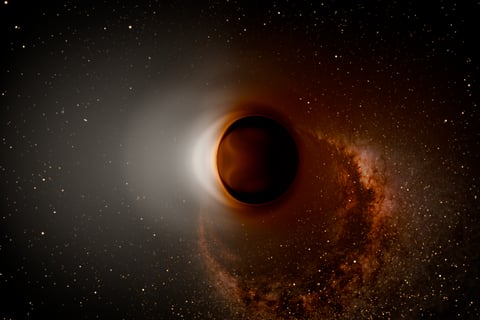
Side on 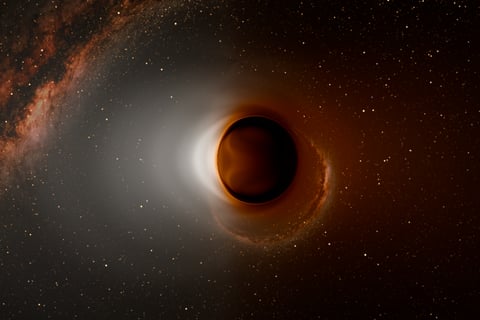
Low angle 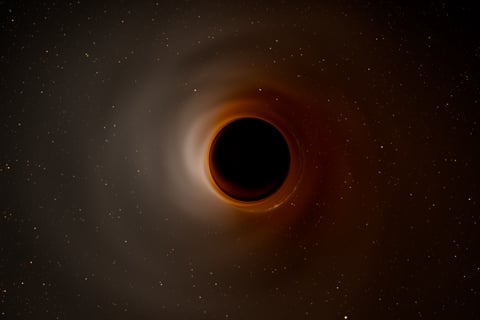
From above 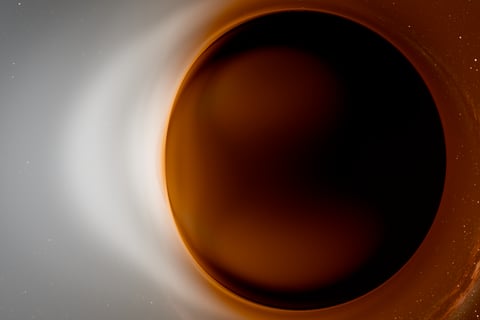
Close 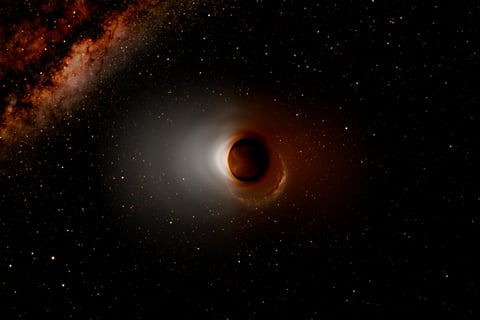
Far 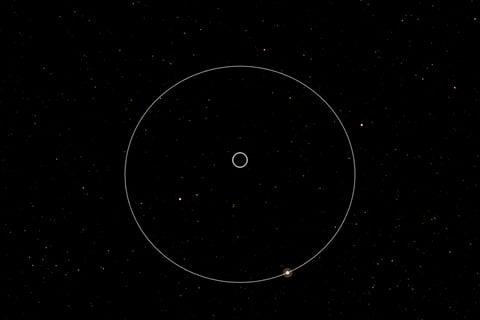
The whole system
Drawn live, it can also be turned, and you can change how fast it spins and feeds.
Sign in if you have an invite code, or join the waitlist.
Where the numbers come from
There is no catalogue of black holes as such, as far as we know. A hole goes by the name of something we can see: the star orbiting it, the X-ray source, the galaxy around it. When two black holes merge into one, the new hole is named for the date the ripple in space from the merger (its gravitational waves) reached the detectors on Earth that listen for them. SIMBAD is astronomers' online catalogue of objects beyond the Solar System. Known as: in SIMBAD, V404 Cyg, Ginga 2023+338, NOVA Cyg 1989, NOVA Cyg 1938 and Gaia DR3 2056188624872569088.
- Mass, in M☉ (the Sun's mass): 9.0 +0.2/−0.6 M☉ (the authors advise caution), from the companion star's light curve in the infrared as the hole's pull stretches it, corrected for the disc's own light. J. Khargharia, C. S. Froning and E. L. Robinson, “Near-Infrared Spectroscopy of Low Mass X-ray Binaries: Accretion Disk Contamination and Compact Object Mass Determination in V404 Cyg and Cen X-4”, The Astrophysical Journal 716, 1105 (2010). doi:10.1088/0004-637X/716/2/1105, arXiv:1004.5358
- Spin, a* (0 is still, 1 is the fastest a hole can turn): > 0.92, from reflection, from NuSTAR during the 2015 flares, at 99% confidence. D. J. Walton et al., “Living on a Flare: Relativistic Reflection in V404 Cyg Observed by NuSTAR During its Summer 2015 Outburst”, The Astrophysical Journal 839, 110 (2017). doi:10.3847/1538-4357/aa67e8, arXiv:1609.01293
- Spin: 0.935 +0.037/−0.075, from reflection, refitting every NuSTAR observation. Where a spin has several published values, each one is listed with its method. The picture is drawn at the middle of the range of published values. P. A. Draghis et al., “Systematically Revisiting All NuSTAR Spins of Black Holes in X-Ray Binaries”, The Astrophysical Journal 969, 40 (2024). doi:10.3847/1538-4357/ad43ea, arXiv:2311.16225
- Spin drawn: 0.929, the middle of the range of published values (spin assumed).
- Feed: 7.85 × 10⁻⁷ (when quiet; in the 2015 outburst it reached, and at times passed, the Eddington rate), from its X-ray light when quiet, 8.9 × 10³² erg/s from 0.3 to 30 keV, over the Eddington luminosity for this mass; X-rays only, not all its light. V. Rana et al., “Characterizing X-ray and Radio emission in the Black Hole X-Ray Binary V404 Cygni during Quiescence”, The Astrophysical Journal 821, 103 (2016). doi:10.3847/0004-637X/821/2/103, arXiv:1507.04049 and S. E. Motta et al., “Swift observations of V404 Cyg during the 2015 outburst: X-ray outflows from super-Eddington accretion”, Monthly Notices of the Royal Astronomical Society (2017). doi:10.1093/mnras/stx1699, arXiv:1707.01076
- 2015 outburst, feed: In the 2015 outburst it fed near the Eddington rate, and above it in 3% of more than 1 000 Swift spectra; no single figure is published. S. E. Motta et al., “Swift observations of V404 Cyg during the 2015 outburst: X-ray outflows from super-Eddington accretion”, Monthly Notices of the Royal Astronomical Society (2017). doi:10.1093/mnras/stx1699, arXiv:1707.01076
- Angle: 67 +3/−1°, from the tilt of the star's orbit, from its light curve; X-ray studies put the inner disc at 37° to 52°, and in 2015 the jet's direction changed within minutes. J. Khargharia, C. S. Froning and E. L. Robinson, “Near-Infrared Spectroscopy of Low Mass X-ray Binaries: Accretion Disk Contamination and Compact Object Mass Determination in V404 Cyg and Cen X-4”, The Astrophysical Journal 716, 1105 (2010). doi:10.1088/0004-637X/716/2/1105, arXiv:1004.5358 and P. A. Draghis et al., “Systematically Revisiting All NuSTAR Spins of Black Holes in X-Ray Binaries”, The Astrophysical Journal 969, 40 (2024). doi:10.3847/1538-4357/ad43ea, arXiv:2311.16225 and J. C. A. Miller-Jones et al., “A rapidly-changing jet orientation in the stellar-mass black hole V404 Cygni”, Nature 569, 374 (2019). doi:10.1038/s41586-019-1152-0, arXiv:1906.05400
- Distance: 7 795 ± 457 light years (2.39 ± 0.14 kpc (kiloparsecs, each a thousand parsecs of 3.26 light years), the first accurate parallax to a black hole), from radio parallax. J. C. A. Miller-Jones et al., “The first accurate parallax distance to a black hole”, The Astrophysical Journal Letters 706, L230 (2009). doi:10.1088/0004-637X/706/2/L230, arXiv:0910.5253
- The companion star's orbit, once round: 6.47117 ± 0.000002 days, from the star's radial velocities from 1990 to 2018 (Table 3). J. Casares et al., “Accretion and outflow in V404 Cyg”, Monthly Notices of the Royal Astronomical Society 488, 1356 (2019), Table 3. doi:10.1093/mnras/stz1793, arXiv:1907.00005
- Its distance from the hole, halfway between nearest and farthest: 0.144 au, from Kepler's third law, from the period and the two masses, 9.0 and 0.54 suns. J. Casares et al., “Accretion and outflow in V404 Cyg”, Monthly Notices of the Royal Astronomical Society 488, 1356 (2019), Table 3. doi:10.1093/mnras/stz1793, arXiv:1907.00005 and J. Khargharia, C. S. Froning and E. L. Robinson, “Near-Infrared Spectroscopy of Low Mass X-ray Binaries: Accretion Disk Contamination and Compact Object Mass Determination in V404 Cyg and Cen X-4”, The Astrophysical Journal 716, 1105 (2010). doi:10.1088/0004-637X/716/2/1105, arXiv:1004.5358
- Its eccentricity (0 is a circle): 0 (assumed: a circle fits the velocities), from a sine wave fitted to the star's radial velocities (§4.2). J. Casares et al., “Accretion and outflow in V404 Cyg”, Monthly Notices of the Royal Astronomical Society 488, 1356 (2019), Table 3. doi:10.1093/mnras/stz1793, arXiv:1907.00005
- How it lies on our sky: not measured, since only the star's speed towards and away from us is known. The zoomed-out orbit is drawn with its rising node due north, going round anticlockwise, and with the star in front of the hole on 27 June 2015 (± 0.002 days), from the velocity fit's phase zero (Table 3), which the paper does not name, taken here as the star passing in front of the hole. J. Casares et al., “Accretion and outflow in V404 Cyg”, Monthly Notices of the Royal Astronomical Society 488, 1356 (2019), Table 3. doi:10.1093/mnras/stz1793, arXiv:1907.00005
- The companion star's mass: 0.54 M☉, from the mass ratio, 0.060, times the hole's 9.0 suns. J. Khargharia, C. S. Froning and E. L. Robinson, “Near-Infrared Spectroscopy of Low Mass X-ray Binaries: Accretion Disk Contamination and Compact Object Mass Determination in V404 Cyg and Cen X-4”, The Astrophysical Journal 716, 1105 (2010). doi:10.1088/0004-637X/716/2/1105, arXiv:1004.5358
- The companion star's radius: not published
- The companion star's surface temperature: 4 300 K, from the model fitted to its infrared spectrum (its lines give 4 200 to 4 600 K). J. Khargharia, C. S. Froning and E. L. Robinson, “Near-Infrared Spectroscopy of Low Mass X-ray Binaries: Accretion Disk Contamination and Compact Object Mass Determination in V404 Cyg and Cen X-4”, The Astrophysical Journal 716, 1105 (2010). doi:10.1088/0004-637X/716/2/1105, arXiv:1004.5358
- Apparent jet speed: the blobs it threw out in 2015 crossed the sky at between 0.06 and 0.64 times the speed of light, as seen from here. Their true speed is unlikely to be one number: the authors conclude that the jet's speed or its direction, or both, kept changing J. C. A. Miller-Jones et al., “A rapidly-changing jet orientation in the stellar-mass black hole V404 Cygni”, Nature 569, 374 (2019). doi:10.1038/s41586-019-1152-0, arXiv:1906.05400
Every number on this page is quoted from a published paper or a catalogue, with the method it came from. No image or data file from these sources is loaded, so there is nothing to licence; the figure is our own drawing from their numbers.
More real black holes we draw
- Gaia BH1, a dormant black hole (one that is not feeding, so it gives off almost no light) with a Sun-like star circling it every 186 days
- Gaia BH3, a dormant black hole with an old giant star on an 11.6-year orbit; the heaviest known black hole in our Galaxy to be born from a single star
- GW150914 remnant, the black hole left when two black holes merged, the first such merger ever detected
- TON 618, a quasar (a galaxy's core lit up by the black hole feeding at its centre), among the heaviest black holes known
- 3C 273, the first quasar identified, and the brightest in our sky
- Sagittarius A*, the black hole at the centre of our Galaxy
- M87*, the black hole in the giant galaxy M87, the first to be pictured: a dark circle against the glowing gas around it
- Cygnus X-1, a black hole feeding on the wind of a giant star, seen in two states
- GRS 1915+105, a black hole that fed about as fast as a black hole can for 26 years, throwing out jets