A real black hole
M87*
The black hole in the giant galaxy M87, the first to be pictured: a dark circle against the glowing gas around it.
In 2019 the Event Horizon Telescope showed the first picture of a black hole's shadow. It was this one, at the heart of the giant galaxy M87, about 55 million light years away and six and a half billion times the Sun's mass. It feeds slowly, yet its jet streams out at more than nine tenths of the speed of light.
How we draw it today
These are stills from the program that draws every black hole on BlackHoles.fyi, worked out from what astronomers have measured about M87*: its mass and, where they are known, its spin and how fast it feeds. The site is open to a small group of testers while we finish it; signed in, they see these same views drawn live and can move between them.
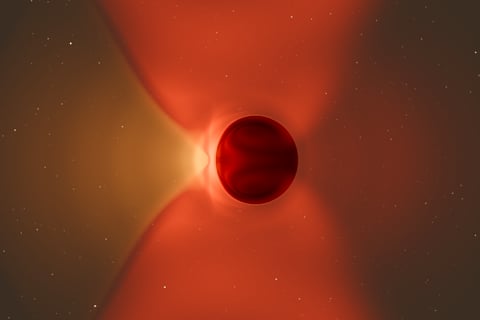
Side on 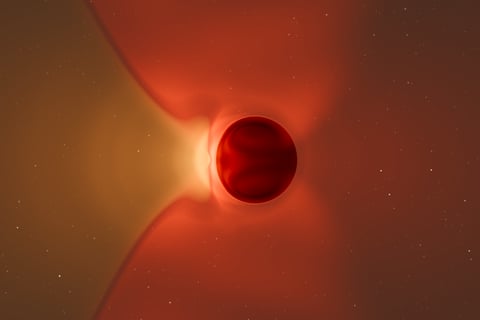
Low angle 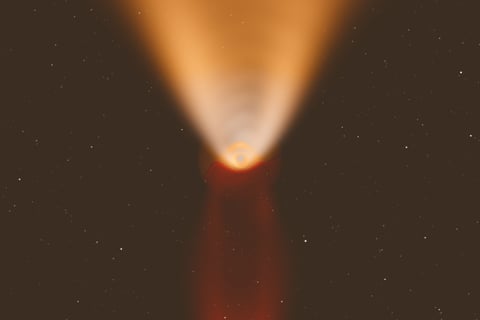
From above 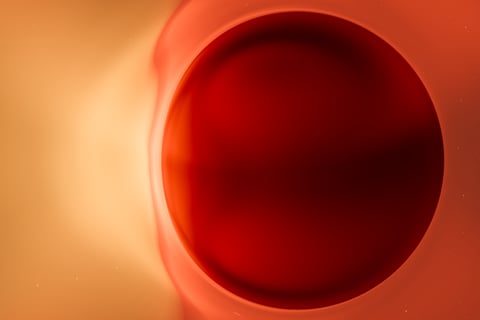
Close 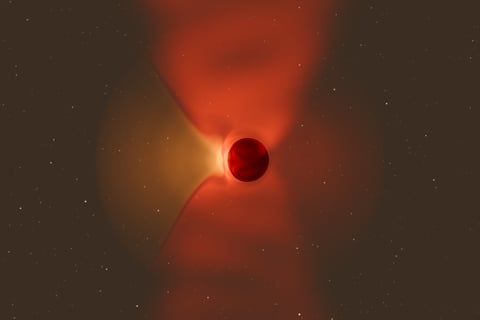
Far 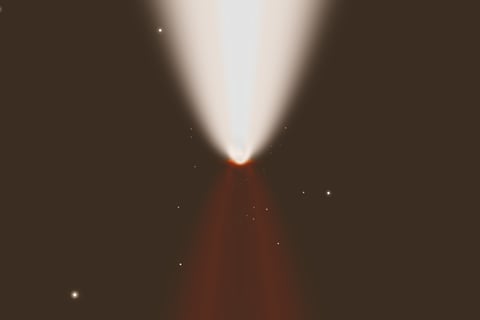
As seen from Earth 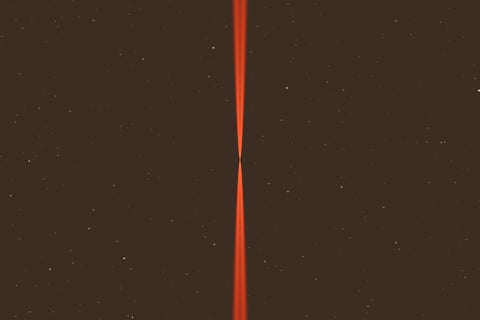
Jet
Drawn live, it can also be turned, and you can change how fast it spins and feeds.
Sign in if you have an invite code, or join the waitlist.
Where the numbers come from
There is no catalogue of black holes as such, as far as we know. A hole goes by the name of something we can see: the star orbiting it, the X-ray source, the galaxy around it. When two black holes merge into one, the new hole is named for the date the ripple in space from the merger (its gravitational waves) reached the detectors on Earth that listen for them. SIMBAD is astronomers' online catalogue of objects beyond the Solar System. NED is NASA's catalogue of objects beyond our Galaxy. Known as: in SIMBAD, M 87 (the galaxy's name, which SIMBAD uses for the hole), M 87*, NGC 4486, Virgo A and 3C 274; in NED, Messier 087.
- Mass, in M☉ (the Sun's mass): 6.5 × 10⁹ ± 7 × 10⁸ M☉ (6.5 billion, ± 0.2 billion from the measurement and ± 0.7 billion from the method; the motion of its gas gives a lighter 3.5 +0.9/−0.7 billion), from the size of the ring in the Event Horizon Telescope image, at the distance below. Event Horizon Telescope Collaboration, “First M87 Event Horizon Telescope Results. VI. The Shadow and Mass of the Central Black Hole”, The Astrophysical Journal Letters 875, L6 (2019). doi:10.3847/2041-8213/ab1141, arXiv:1906.11243 and J. L. Walsh et al., “The M87 Black Hole Mass from Gas-dynamical Models of Space Telescope Imaging Spectrograph Observations”, The Astrophysical Journal 770, 86 (2013). doi:10.1088/0004-637X/770/2/86, arXiv:1304.7273
- Spin, a* (0 is still, 1 is the fastest a hole can turn): 0.90 ± 0.05, from the twist in the light of the Event Horizon Telescope image, at about 95% confidence. F. Tamburini, B. Thidé and M. Della Valle, “Measurement of the spin of the M87 black hole from its observed twisted light”, Monthly Notices of the Royal Astronomical Society Letters (2020). doi:10.1093/mnrasl/slz176, arXiv:1904.07923
- Spin: > 0.8 (about 0.8, which the authors say is probably a lower limit), from how fast the inner gas turns, about 0.14 times the speed of light, read from the Event Horizon Telescope image. M. Drew et al., “New estimates of the spin and accretion rate of the black hole M87*”, The Astrophysical Journal Letters 984, L31 (2025). doi:10.3847/2041-8213/adc90e, arXiv:2505.17035
- Spin: No value. Models of the Event Horizon Telescope image with no spin make jets too weak to match. Where a spin has several published values, each one is listed with its method. The picture is drawn at the middle of the range of published values. Event Horizon Telescope Collaboration, “First M87 Event Horizon Telescope Results. V. Physical Origin of the Asymmetric Ring”, The Astrophysical Journal Letters 875, L5 (2019). doi:10.3847/2041-8213/ab0f43, arXiv:1906.11242
- Spin drawn: 0.899, the middle of the range of published values (spin assumed).
- Feed: 2 × 10⁻⁵ (a feeding rate rather than a measure of its light; models that fit the image span 2 × 10⁻⁷ to 4 × 10⁻⁴), from the rate gas falls in, estimated from the density and size of the glowing region, over the rate that would make it shine at the Eddington limit. Event Horizon Telescope Collaboration, “First M87 Event Horizon Telescope Results. V. Physical Origin of the Asymmetric Ring”, The Astrophysical Journal Letters 875, L5 (2019). doi:10.3847/2041-8213/ab0f43, arXiv:1906.11242
- Angle: 17.2 ± 3.3°, from the jet's angle to our line of sight, from the speeds and brightness of the jet and the fainter jet on the far side; another study puts it under 18.6°. F. Mertens et al., “Kinematics of the jet in M87 on scales of 100–1000 Schwarzschild radii”, Astronomy & Astrophysics 595, A54 (2016), eq. 4. doi:10.1051/0004-6361/201628829, arXiv:1608.05063 and R. C. Walker et al., “The Structure and Dynamics of the Sub-parsec Scale Jet in M87 Based on 50 VLBA Observations Over 17 Years at 43 GHz”, The Astrophysical Journal 855, 128 (2018). doi:10.3847/1538-4357/aaafcc, arXiv:1802.06166
- Distance: 5.48 × 10⁷ +2.61 × 10⁶/−2.28 × 10⁶ light years (16.8 +0.8/−0.7 Mpc, megaparsecs, each a million parsecs of 3.26 light years), from the distance the Event Horizon Telescope adopted from earlier measurements. Event Horizon Telescope Collaboration, “First M87 Event Horizon Telescope Results. VI. The Shadow and Mass of the Central Black Hole”, The Astrophysical Journal Letters 875, L6 (2019). doi:10.3847/2041-8213/ab1141, arXiv:1906.11243
- Jet speed: 0.92 times the speed of light (the fast stream at its centre; a slower outer layer moves at about 0.5), from the motion of features in radio images of the jet within a parsec of the hole, at 43 GHz. F. Mertens et al., “Kinematics of the jet in M87 on scales of 100–1000 Schwarzschild radii”, Astronomy & Astrophysics 595, A54 (2016), eq. 4. doi:10.1051/0004-6361/201628829, arXiv:1608.05063
Every number on this page is quoted from a published paper or a catalogue, with the method it came from. No image or data file from these sources is loaded, so there is nothing to licence; the figure is our own drawing from their numbers.
More real black holes we draw
- Gaia BH1, a dormant black hole (one that is not feeding, so it gives off almost no light) with a Sun-like star circling it every 186 days
- Gaia BH3, a dormant black hole with an old giant star on an 11.6-year orbit; the heaviest known black hole in our Galaxy to be born from a single star
- GW150914 remnant, the black hole left when two black holes merged, the first such merger ever detected
- TON 618, a quasar (a galaxy's core lit up by the black hole feeding at its centre), among the heaviest black holes known
- 3C 273, the first quasar identified, and the brightest in our sky
- Sagittarius A*, the black hole at the centre of our Galaxy
- Cygnus X-1, a black hole feeding on the wind of a giant star, seen in two states
- GRS 1915+105, a black hole that fed about as fast as a black hole can for 26 years, throwing out jets
- V404 Cygni, a black hole that is quiet for decades, then flares