A real black hole
Sagittarius A*
The black hole at the centre of our Galaxy.
The black hole at the centre of our Galaxy, 27 000 light years away. We can weigh it, at 4.3 million times the mass of the Sun, because we can watch stars swing round it. It barely feeds: its glow is less than a billionth of the most it could give out, and no jet has been found.
How we draw it today
These are stills from the program that draws every black hole on BlackHoles.fyi, worked out from what astronomers have measured about Sagittarius A*: its mass and, where they are known, its spin and how fast it feeds. The site is open to a small group of testers while we finish it; signed in, they see these same views drawn live and can move between them.
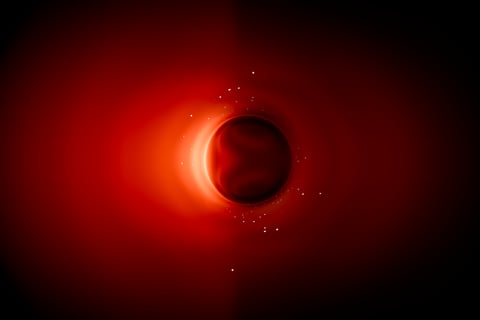
Side on 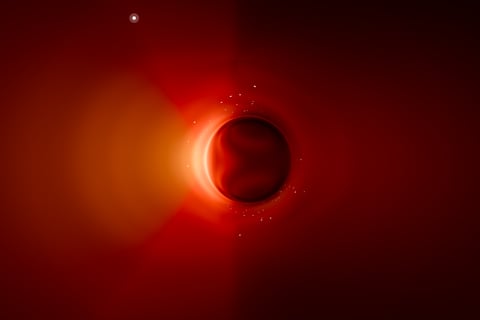
Low angle 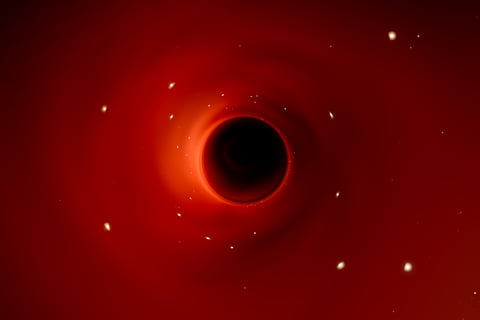
From above 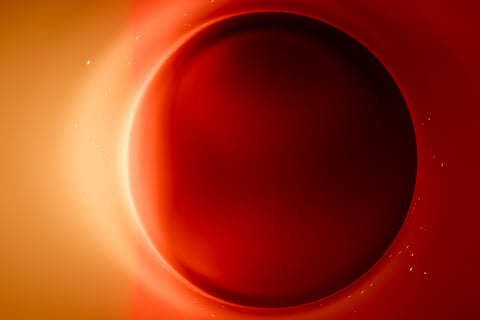
Close 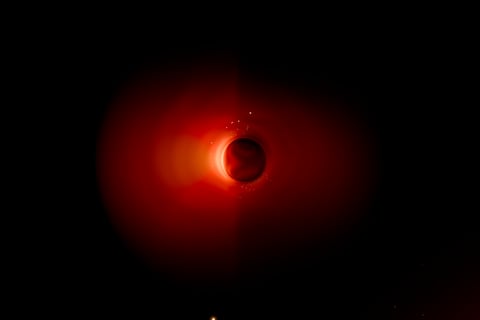
Far 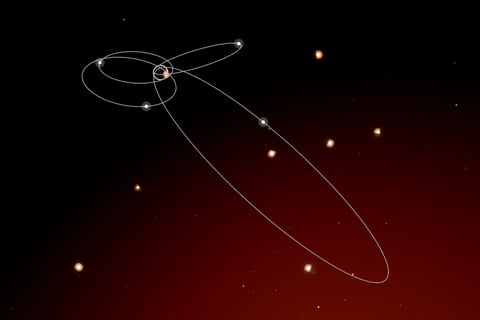
The whole system
Drawn live, it can also be turned, and you can change how fast it spins and feeds.
Sign in if you have an invite code, or join the waitlist.
Where the numbers come from
There is no catalogue of black holes as such, as far as we know. A hole goes by the name of something we can see: the star orbiting it, the X-ray source, the galaxy around it. When two black holes merge into one, the new hole is named for the date the ripple in space from the merger (its gravitational waves) reached the detectors on Earth that listen for them. SIMBAD is astronomers' online catalogue of objects beyond the Solar System. Known as: in SIMBAD, Sgr A* and Sagittarius A*.
- Mass, in M☉ (the Sun's mass): 4.3 × 10⁶ ± 12 000 M☉ (4.297 ± 0.012 million, the error from the fit alone; the method's own uncertainty adds about 0.04 million), from the orbits of four stars round it (S2, S29, S38 and S55), tracked by GRAVITY, an instrument that joins the four big telescopes of the VLT in Chile into one. GRAVITY Collaboration, “The mass distribution in the Galactic Centre from interferometric astrometry of multiple stellar orbits”, Astronomy & Astrophysics 657, L12 (2022), Table 1. doi:10.1051/0004-6361/202142465, arXiv:2112.07478
- Spin, a* (0 is still, 1 is the fastest a hole can turn): < 0.1, from stars orbiting it in flat discs, which a faster spin would have tipped over by now. G. Fragione and A. Loeb, “An upper limit on the spin of SgrA* based on stellar orbits in its vicinity”, The Astrophysical Journal Letters (2020). doi:10.3847/2041-8213/abb9b4, arXiv:2008.11734
- Spin: 0.90 ± 0.06, from the outflow method, from its X-ray and radio light. R. A. Daly et al., “New Black Hole Spin Values for Sagittarius A* Obtained with the Outflow Method” (2023), preprint. arXiv:2310.12108
- Spin: No value. Models of the Event Horizon Telescope image with no spin fit it less well. Where a spin has several published values, each one is listed with its method. The picture is drawn at the middle of the range of published values. Event Horizon Telescope Collaboration, “First Sagittarius A* Event Horizon Telescope Results. I. The Shadow of the Supermassive Black Hole in the Center of the Milky Way”, The Astrophysical Journal Letters 930, L12 (2022). doi:10.3847/2041-8213/ac6674, arXiv:2311.08680
- Spin drawn: 0.48, the middle of the range of published values (spin assumed).
- Feed: 1.9 × 10⁻¹⁰, from its observed light in quiet, about 10³⁵ erg/s, over the Eddington luminosity for this mass, 5.2 × 10⁴⁴ erg/s. Event Horizon Telescope Collaboration, “First Sagittarius A* Event Horizon Telescope Results. V. Testing Astrophysical Models of the Galactic Center Black Hole”, The Astrophysical Journal Letters 930, L16 (2022). doi:10.3847/2041-8213/ac6672, arXiv:2311.09478
- Angle: Not measured. The Event Horizon Telescope image rules out views more than 50° from face-on, and the models that fit it best are within 30°. Event Horizon Telescope Collaboration, “First Sagittarius A* Event Horizon Telescope Results. I. The Shadow of the Supermassive Black Hole in the Center of the Milky Way”, The Astrophysical Journal Letters 930, L12 (2022). doi:10.3847/2041-8213/ac6674, arXiv:2311.08680 and Event Horizon Telescope Collaboration, “First Sagittarius A* Event Horizon Telescope Results. V. Testing Astrophysical Models of the Galactic Center Black Hole”, The Astrophysical Journal Letters 930, L16 (2022). doi:10.3847/2041-8213/ac6672, arXiv:2311.09478
- Distance: 26 996 ± 29 light years (8 277 ± 9 parsecs (pc; a parsec is 3.26 light years), the error from the fit alone; the method's own uncertainty adds about 30 parsecs), from the same fit to the stars' orbits. GRAVITY Collaboration, “The mass distribution in the Galactic Centre from interferometric astrometry of multiple stellar orbits”, Astronomy & Astrophysics 657, L12 (2022), Table 1. doi:10.1051/0004-6361/202142465, arXiv:2112.07478
- S2: once round every 16.0 years, 1 034.21 ± 0.33 (0.12495 ± 0.00004 arcseconds on the sky, at 8 277 parsecs) au halfway between nearest and farthest, eccentricity 0.88441 ± 0.00006, tilted 134.70 ± 0.03° (over 90° is clockwise as we see it), its rising node 228.19 ± 0.03° east of north, its nearest point 66.25 ± 0.03° on from that, reached on 19 May 2018, from GRAVITY's four-star fit (Table B.1). GRAVITY Collaboration, “The mass distribution in the Galactic Centre from interferometric astrometry of multiple stellar orbits”, Astronomy & Astrophysics 657, L12 (2022), Table B.1. doi:10.1051/0004-6361/202142465, arXiv:2112.07478
- S29: once round every 91.0 years, 3 290 ± 13 (0.3975 ± 0.0016 arcseconds on the sky, at 8 277 parsecs) au halfway between nearest and farthest, eccentricity 0.9693 ± 0.0001, tilted 144.37 ± 0.07° (over 90° is clockwise as we see it), its rising node 7.00 ± 0.33° east of north, its nearest point 205.79 ± 0.33° on from that, reached on 30 May 2021, from GRAVITY's four-star fit (Table B.1). GRAVITY Collaboration, “The mass distribution in the Galactic Centre from interferometric astrometry of multiple stellar orbits”, Astronomy & Astrophysics 657, L12 (2022), Table B.1. doi:10.1051/0004-6361/202142465, arXiv:2112.07478
- S38: once round every 19.5 years, 1 179.80 ± 0.33 (0.14254 ± 0.00004 arcseconds on the sky, at 8 277 parsecs) au halfway between nearest and farthest, eccentricity 0.8145 ± 0.0002, tilted 166.65 ± 0.40° (over 90° is clockwise as we see it), its rising node 109.45 ± 1.00° east of north, its nearest point 27.17 ± 1.02° on from that, reached on 15 September 2022, from GRAVITY's four-star fit (Table B.1). GRAVITY Collaboration, “The mass distribution in the Galactic Centre from interferometric astrometry of multiple stellar orbits”, Astronomy & Astrophysics 657, L12 (2022), Table B.1. doi:10.1051/0004-6361/202142465, arXiv:2112.07478
- S55: once round every 12.3 years, 864.12 ± 0.41 (0.10440 ± 0.00005 arcseconds on the sky, at 8 277 parsecs) au halfway between nearest and farthest, eccentricity 0.7267 ± 0.0002, tilted 158.52 ± 0.22° (over 90° is clockwise as we see it), its rising node 314.94 ± 1.14° east of north, its nearest point 322.78 ± 1.13° on from that, reached on 11 September 2021, from GRAVITY's four-star fit (Table B.1). GRAVITY Collaboration, “The mass distribution in the Galactic Centre from interferometric astrometry of multiple stellar orbits”, Astronomy & Astrophysics 657, L12 (2022), Table B.1. doi:10.1051/0004-6361/202142465, arXiv:2112.07478
- S2's turn, measured, as a multiple of relativity's: 1.10 ± 0.19, from the turn of S2's orbit, tracked through its 2018 closest approach, as a multiple of general relativity's (1 is relativity, 0 is Newton). GRAVITY Collaboration, “Detection of the Schwarzschild precession in the orbit of the star S2 near the Galactic centre massive black hole”, Astronomy & Astrophysics 636, L5 (2020). doi:10.1051/0004-6361/202037813, arXiv:2004.07187
Every number on this page is quoted from a published paper or a catalogue, with the method it came from. No image or data file from these sources is loaded, so there is nothing to licence; the figure is our own drawing from their numbers.
More real black holes we draw
- Gaia BH1, a dormant black hole (one that is not feeding, so it gives off almost no light) with a Sun-like star circling it every 186 days
- Gaia BH3, a dormant black hole with an old giant star on an 11.6-year orbit; the heaviest known black hole in our Galaxy to be born from a single star
- GW150914 remnant, the black hole left when two black holes merged, the first such merger ever detected
- TON 618, a quasar (a galaxy's core lit up by the black hole feeding at its centre), among the heaviest black holes known
- 3C 273, the first quasar identified, and the brightest in our sky
- M87*, the black hole in the giant galaxy M87, the first to be pictured: a dark circle against the glowing gas around it
- Cygnus X-1, a black hole feeding on the wind of a giant star, seen in two states
- GRS 1915+105, a black hole that fed about as fast as a black hole can for 26 years, throwing out jets
- V404 Cygni, a black hole that is quiet for decades, then flares