A real black hole
Gaia BH3
A dormant black hole with an old giant star on an 11.6-year orbit; the heaviest known black hole in our Galaxy to be born from a single star.
Found in 2024 while the next data release from the Gaia spacecraft, which measures the positions of stars, was being checked before it came out: an old star swinging round something 33 times the Sun's mass every 11.6 years. It is the heaviest black hole made by a star that we know of in our Galaxy, and it gives out no light.
How we draw it today
These are stills from the program that draws every black hole on BlackHoles.fyi, worked out from what astronomers have measured about Gaia BH3: its mass and, where they are known, its spin and how fast it feeds. The site is open to a small group of testers while we finish it; signed in, they see these same views drawn live and can move between them.
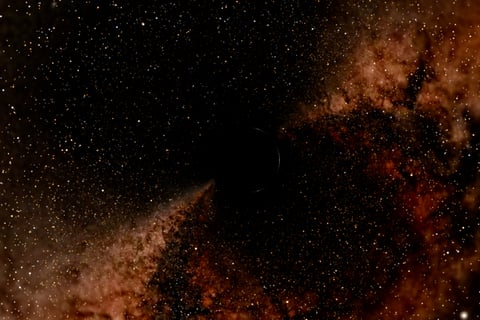
Side on 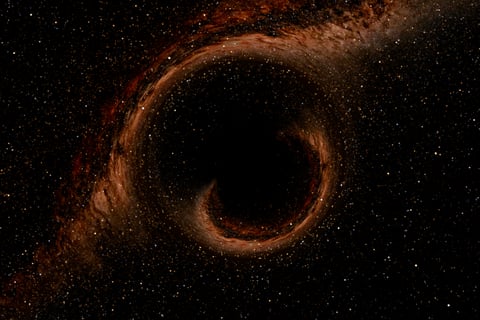
Low angle 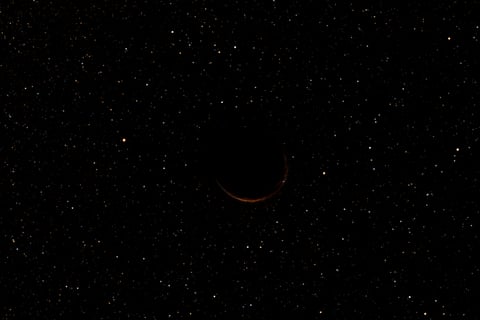
From above 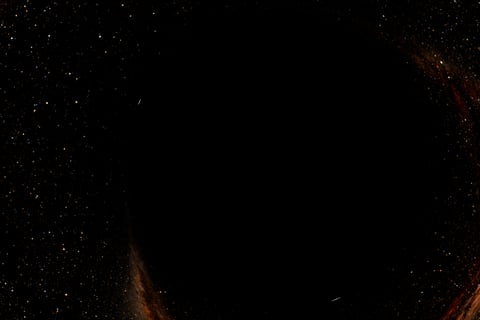
Close 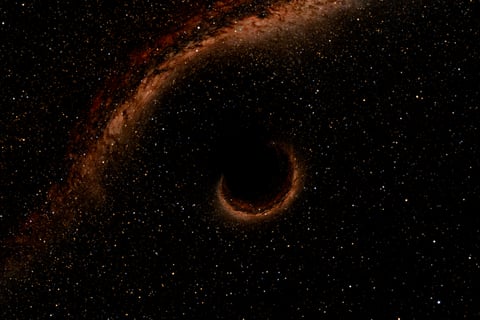
Far 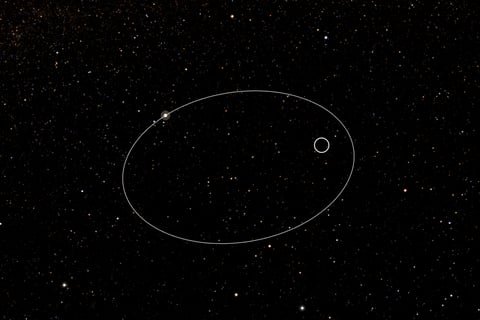
The whole system 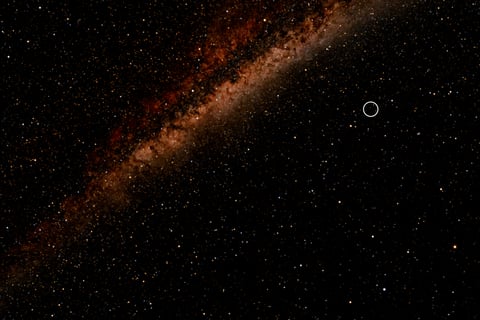
The companion star up close
Drawn live, it can also be turned, and you can change how fast it spins and feeds.
Sign in if you have an invite code, or join the waitlist.
Where the numbers come from
There is no catalogue of black holes as such, as far as we know. A hole goes by the name of something we can see: the star orbiting it, the X-ray source, the galaxy around it. When two black holes merge into one, the new hole is named for the date the ripple in space from the merger (its gravitational waves) reached the detectors on Earth that listen for them. SIMBAD is astronomers' online catalogue of objects beyond the Solar System. Known as: in SIMBAD, LS II +14 13 (the companion star's name, which SIMBAD uses for the pair), Gaia DR3 4318465066420528000 and 2MASS J19391872+1455542.
- Mass, in M☉ (the Sun's mass): 32.70 ± 0.82 M☉, from the giant star's astrometric orbit in pre-release Gaia data, with radial velocities. Gaia Collaboration, P. Panuzzo et al., “Discovery of a dormant 33 solar-mass black hole in pre-release Gaia astrometry”, Astronomy & Astrophysics Letters (2024). doi:10.1051/0004-6361/202449763, arXiv:2404.10486
- Spin, a* (0 is still, 1 is the fastest a hole can turn): No published measurement that we could find.
- Spin drawn: 0.6, the value the homepage picture starts on. We found no published value, so this is an assumption.
- Feed: No measurement was checked for this hole; nothing is seen falling in.
- Angle: 110.6 ± 0.1°, from the star's orbital inclination (Table 2; the two fits give 110.58 ± 0.10 and 110.66 ± 0.11). The angle is the tilt of the companion star's orbit, drawn as if it were the disc's plane; over 90° means the star goes round clockwise as we see it, so the view is 69° from face-on. Gaia Collaboration, P. Panuzzo et al., “Discovery of a dormant 33 solar-mass black hole in pre-release Gaia astrometry”, Astronomy & Astrophysics Letters (2024). doi:10.1051/0004-6361/202449763, arXiv:2404.10486
- Distance: 1 920 light years (590 pc), from Gaia parallax. Gaia Collaboration, P. Panuzzo et al., “Discovery of a dormant 33 solar-mass black hole in pre-release Gaia astrometry”, Astronomy & Astrophysics Letters (2024). doi:10.1051/0004-6361/202449763, arXiv:2404.10486
- The companion star's orbit, once round: 4 253.1 ± 98.5 days, from the combined solution (Table 2). Gaia Collaboration, P. Panuzzo et al., “Discovery of a dormant 33 solar-mass black hole in pre-release Gaia astrometry”, Astronomy & Astrophysics Letters (2024). doi:10.1051/0004-6361/202449763, arXiv:2404.10486
- Its distance from the hole, halfway between nearest and farthest: 16.55 ± 0.28 au, from the star's orbit round the pair's centre, 16.17 ± 0.27 au (Table 2), scaled up by the total mass over the hole's, (32.70 + 0.76) / 32.70. Gaia Collaboration, P. Panuzzo et al., “Discovery of a dormant 33 solar-mass black hole in pre-release Gaia astrometry”, Astronomy & Astrophysics Letters (2024). doi:10.1051/0004-6361/202449763, arXiv:2404.10486
- Its eccentricity (0 is a circle): 0.7291 ± 0.0048, from the combined solution (Table 2). Gaia Collaboration, P. Panuzzo et al., “Discovery of a dormant 33 solar-mass black hole in pre-release Gaia astrometry”, Astronomy & Astrophysics Letters (2024). doi:10.1051/0004-6361/202449763, arXiv:2404.10486
- How it lies on our sky: its rising node 136.236 ± 0.128° east of north, its nearest point 77.34 ± 0.76° on from that, reached on 27 February 2018 (± 0.88 days), from the combined solution (Table 2). Gaia Collaboration, P. Panuzzo et al., “Discovery of a dormant 33 solar-mass black hole in pre-release Gaia astrometry”, Astronomy & Astrophysics Letters (2024). doi:10.1051/0004-6361/202449763, arXiv:2404.10486
- The companion star's mass: 0.76 ± 0.05 M☉, from stellar models fitted to its spectrum and brightness (Table 3). Gaia Collaboration, P. Panuzzo et al., “Discovery of a dormant 33 solar-mass black hole in pre-release Gaia astrometry”, Astronomy & Astrophysics Letters (2024). doi:10.1051/0004-6361/202449763, arXiv:2404.10486
- The companion star's radius: 4.936 ± 0.016 solar radii, from its brightness and temperature (Table 3). Gaia Collaboration, P. Panuzzo et al., “Discovery of a dormant 33 solar-mass black hole in pre-release Gaia astrometry”, Astronomy & Astrophysics Letters (2024). doi:10.1051/0004-6361/202449763, arXiv:2404.10486
- The companion star's surface temperature: 5 212 ± 80 K, from its spectrum (Table 3). Gaia Collaboration, P. Panuzzo et al., “Discovery of a dormant 33 solar-mass black hole in pre-release Gaia astrometry”, Astronomy & Astrophysics Letters (2024). doi:10.1051/0004-6361/202449763, arXiv:2404.10486
Every number on this page is quoted from a published paper or a catalogue, with the method it came from. No image or data file from these sources is loaded, so there is nothing to licence; the figure is our own drawing from their numbers.
More real black holes we draw
- Gaia BH1, a dormant black hole (one that is not feeding, so it gives off almost no light) with a Sun-like star circling it every 186 days
- GW150914 remnant, the black hole left when two black holes merged, the first such merger ever detected
- TON 618, a quasar (a galaxy's core lit up by the black hole feeding at its centre), among the heaviest black holes known
- 3C 273, the first quasar identified, and the brightest in our sky
- Sagittarius A*, the black hole at the centre of our Galaxy
- M87*, the black hole in the giant galaxy M87, the first to be pictured: a dark circle against the glowing gas around it
- Cygnus X-1, a black hole feeding on the wind of a giant star, seen in two states
- GRS 1915+105, a black hole that fed about as fast as a black hole can for 26 years, throwing out jets
- V404 Cygni, a black hole that is quiet for decades, then flares