A real black hole
GW150914 remnant
The black hole left when two black holes merged, the first such merger ever detected.
On 14 September 2015 both LIGO detectors felt space itself stretch and squeeze: the first gravitational waves ever detected. Two black holes, of about 36 and 31 Suns, had merged about 1.2 billion years ago into one of 63 Suns, spinning at 0.69 of the maximum.
How we draw it today
These are stills from the program that draws every black hole on BlackHoles.fyi, worked out from what astronomers have measured about GW150914 remnant: its mass and, where they are known, its spin and how fast it feeds. The site is open to a small group of testers while we finish it; signed in, they see these same views drawn live and can move between them.
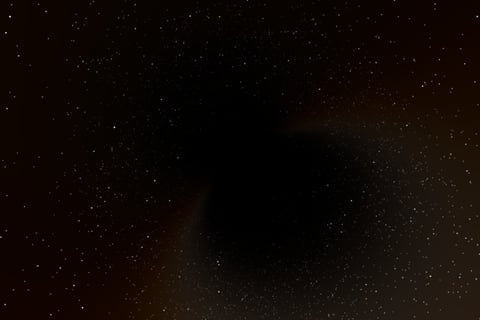
Side on 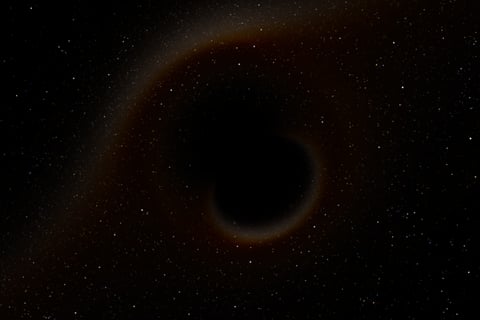
Low angle 
From above 
Close 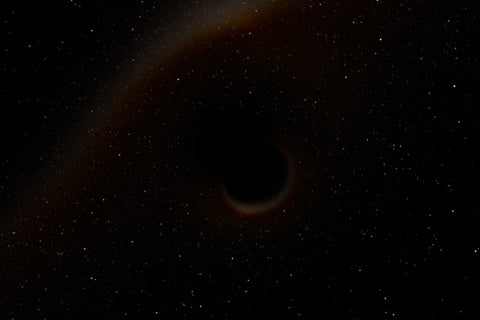
Far
Drawn live, it can also be turned, and you can change how fast it spins and feeds.
Sign in if you have an invite code, or join the waitlist.
Where the numbers come from
There is no catalogue of black holes as such, as far as we know. A hole goes by the name of something we can see: the star orbiting it, the X-ray source, the galaxy around it. When two black holes merge into one, the new hole is named for the date the ripple in space from the merger (its gravitational waves) reached the detectors on Earth that listen for them. Known as: at the Gravitational Wave Open Science Center, GW150914.
- Mass, in M☉ (the Sun's mass): 63.1 +3.4/−3.0 M☉, from the final mass fitted to the gravitational-wave signal, in the source's frame. LIGO Scientific Collaboration and Virgo Collaboration, “GWTC-1: A Gravitational-Wave Transient Catalog of Compact Binary Mergers Observed by LIGO and Virgo during the First and Second Observing Runs”, Physical Review X 9, 031040 (2019), Table III. doi:10.1103/PhysRevX.9.031040, arXiv:1811.12907 and Gravitational Wave Open Science Center, event record GW150914 (GWTC-1-confident, v3). doi:10.7935/82H3-HH23
- Spin, a* (0 is still, 1 is the fastest a hole can turn): 0.69 +0.05/−0.04, from the final spin fitted to the gravitational-wave signal, through numerical-relativity fits to the parents' masses and spins. LIGO Scientific Collaboration and Virgo Collaboration, “GWTC-1: A Gravitational-Wave Transient Catalog of Compact Binary Mergers Observed by LIGO and Virgo during the First and Second Observing Runs”, Physical Review X 9, 031040 (2019), Table III. doi:10.1103/PhysRevX.9.031040, arXiv:1811.12907
- Feed: No light has been detected from it; nothing is known to be falling in.
- Angle: The orbit's tilt to our line of sight is poorly measured for this event. LIGO Scientific Collaboration and Virgo Collaboration, “GWTC-1: A Gravitational-Wave Transient Catalog of Compact Binary Mergers Observed by LIGO and Virgo during the First and Second Observing Runs”, Physical Review X 9, 031040 (2019), Table III. doi:10.1103/PhysRevX.9.031040, arXiv:1811.12907 and LIGO Scientific Collaboration and Virgo Collaboration, “Improved Analysis of GW150914 Using a Fully Spin-Precessing Waveform Model”, Physical Review X 6, 041014 (2016), §IV. doi:10.1103/PhysRevX.6.041014
- Distance: 1.44 × 10⁹ +4.89 × 10⁸/−5.54 × 10⁸ light years (440 +150/−170 Mpc), from luminosity distance, from how loud the waves arrived for the masses they imply. LIGO Scientific Collaboration and Virgo Collaboration, “GWTC-1: A Gravitational-Wave Transient Catalog of Compact Binary Mergers Observed by LIGO and Virgo during the First and Second Observing Runs”, Physical Review X 9, 031040 (2019), Table III. doi:10.1103/PhysRevX.9.031040, arXiv:1811.12907 and Gravitational Wave Open Science Center, event record GW150914 (GWTC-1-confident, v3). doi:10.7935/82H3-HH23
- Redshift: 0.09 ± 0.03, from from the luminosity distance and the assumed cosmology. LIGO Scientific Collaboration and Virgo Collaboration, “GWTC-1: A Gravitational-Wave Transient Catalog of Compact Binary Mergers Observed by LIGO and Virgo during the First and Second Observing Runs”, Physical Review X 9, 031040 (2019), Table III. doi:10.1103/PhysRevX.9.031040, arXiv:1811.12907
Every number on this page is quoted from a published paper or a catalogue, with the method it came from. No image or data file from these sources is loaded, so there is nothing to licence; the figure is our own drawing from their numbers.
More real black holes we draw
- Gaia BH1, a dormant black hole (one that is not feeding, so it gives off almost no light) with a Sun-like star circling it every 186 days
- Gaia BH3, a dormant black hole with an old giant star on an 11.6-year orbit; the heaviest known black hole in our Galaxy to be born from a single star
- TON 618, a quasar (a galaxy's core lit up by the black hole feeding at its centre), among the heaviest black holes known
- 3C 273, the first quasar identified, and the brightest in our sky
- Sagittarius A*, the black hole at the centre of our Galaxy
- M87*, the black hole in the giant galaxy M87, the first to be pictured: a dark circle against the glowing gas around it
- Cygnus X-1, a black hole feeding on the wind of a giant star, seen in two states
- GRS 1915+105, a black hole that fed about as fast as a black hole can for 26 years, throwing out jets
- V404 Cygni, a black hole that is quiet for decades, then flares