A real black hole
TON 618
A quasar (a galaxy's core lit up by the black hole feeding at its centre), among the heaviest black holes known.
Its name is its number in a catalogue of faint blue objects from the Tonantzintla observatory in Mexico. It is a quasar whose light set out almost 11 billion years ago, powered by one of the heaviest black holes known, tens of billions of times the Sun's mass. That mass comes from how fast the gas round it is moving, and is good to about a factor of two. Radio telescopes see a jet of gas shooting out of its core.
How we draw it today
These are stills from the program that draws every black hole on BlackHoles.fyi, worked out from what astronomers have measured about TON 618: its mass and, where they are known, its spin and how fast it feeds. The site is open to a small group of testers while we finish it; signed in, they see these same views drawn live and can move between them.
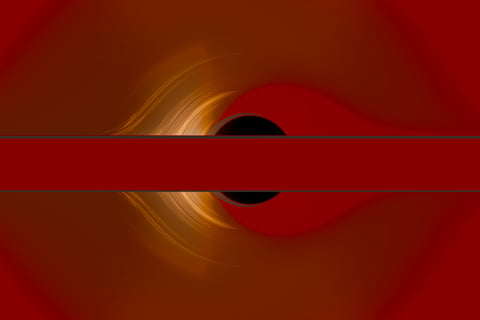
Side on 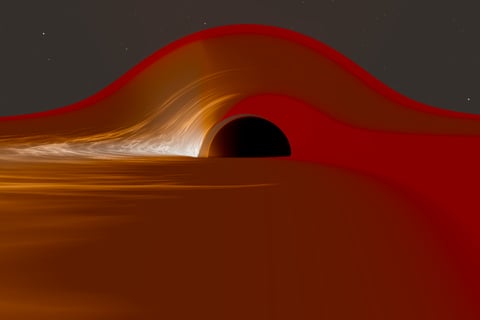
Low angle 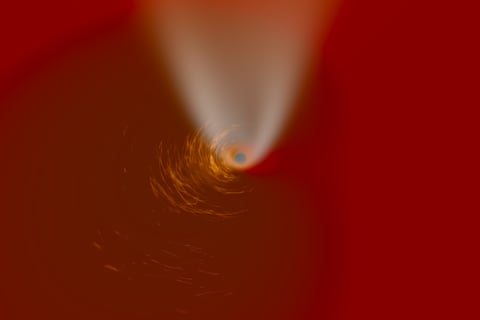
From above 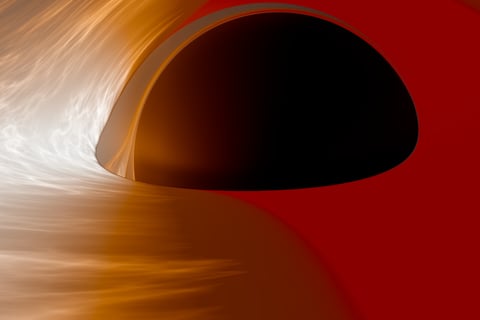
Close 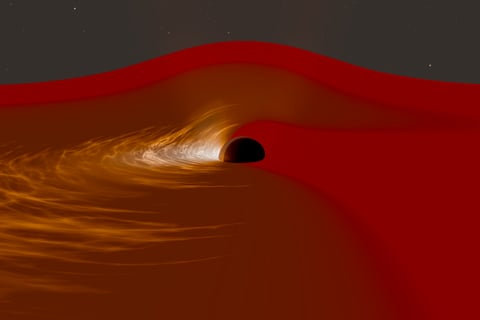
Far 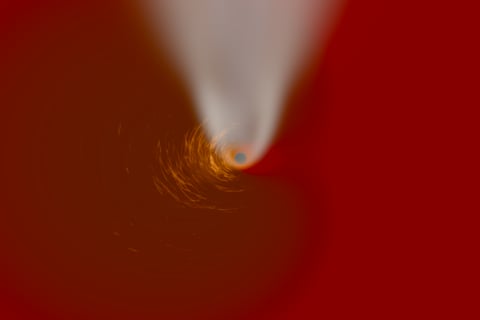
As seen from Earth 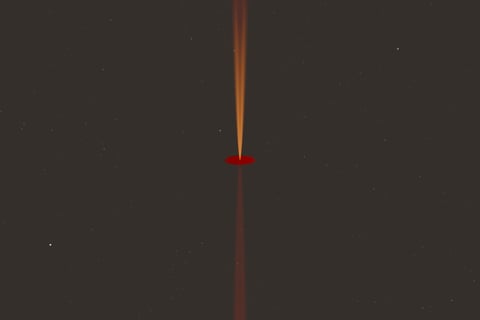
Jet
Drawn live, it can also be turned, and you can change how fast it spins and feeds.
Sign in if you have an invite code, or join the waitlist.
Where the numbers come from
There is no catalogue of black holes as such, as far as we know. A hole goes by the name of something we can see: the star orbiting it, the X-ray source, the galaxy around it. When two black holes merge into one, the new hole is named for the date the ripple in space from the merger (its gravitational waves) reached the detectors on Earth that listen for them. SIMBAD is astronomers' online catalogue of objects beyond the Solar System. NED is NASA's catalogue of objects beyond our Galaxy. Known as: in SIMBAD, Ton 618, B2 1225+31 and QSO B1225+317; in NED, FBQS J122824.9+312837.
- Mass, in M☉ (the Sun's mass): 6.6 × 10¹⁰ M☉ (good to no more than a factor of two, the paper says (log M = 10.82)), from the width of the Hβ emission line with the continuum luminosity at 5100 Å, a single-epoch virial estimate. O. Shemmer et al., “Near-Infrared Spectroscopy of High-Redshift Active Galactic Nuclei. I. A Metallicity-Accretion Rate Relationship”, The Astrophysical Journal 614, 547 (2004), Table 2. arXiv:astro-ph/0406559
- Spin, a* (0 is still, 1 is the fastest a hole can turn): No published measurement that we could find.
- Spin drawn: 0.6, the value the homepage picture starts on. We found no published value, so this is an assumption.
- Feed: 0.14, from the bolometric luminosity, from the 5100 Å continuum, over the Eddington luminosity for this mass. O. Shemmer et al., “Near-Infrared Spectroscopy of High-Redshift Active Galactic Nuclei. I. A Metallicity-Accretion Rate Relationship”, The Astrophysical Journal 614, 547 (2004), Table 2. arXiv:astro-ph/0406559
- Angle: Unknown. A type 1 quasar, so our view of the centre is taken to be open. Y. Shen and L. C. Ho, “The diversity of quasars unified by accretion and orientation”, Nature 513, 210 (2014), Methods. doi:10.1038/nature13712
- Distance: 1.83 × 10¹⁰ light years (5 626 Mpc), from comoving distance, worked out here from the redshift. Worked out here from the redshift for a flat universe with the Planck 2018 values (H₀ = 67.66 km/s/Mpc, Ωm = 0.3097): the comoving distance, how far the object is today. Its light is 10.9 billion years old. Planck Collaboration, “Planck 2018 results. VI. Cosmological parameters”, Astronomy & Astrophysics 641, A6 (2020). doi:10.1051/0004-6361/201833910
- Redshift: 2.2218 ± 0.00006, from NED's preferred value. The NASA/IPAC Extragalactic Database (NED), object lookup, read 2026-10-31. https://ned.ipac.caltech.edu/
- Jet speed: not yet measured, as far as we can find. We found no study that follows the bright blobs in the jet (its knots) from one radio image to the next, which is the usual way a jet's speed is measured J. F. Helmboldt et al., “The VLBA Imaging and Polarimetry Survey at 5 GHz”, The Astrophysical Journal 658, 203 (2007); source J12284+3128. doi:10.1086/511005, arXiv:astro-ph/0611459
Every number on this page is quoted from a published paper or a catalogue, with the method it came from. No image or data file from these sources is loaded, so there is nothing to licence; the figure is our own drawing from their numbers.
More real black holes we draw
- Gaia BH1, a dormant black hole (one that is not feeding, so it gives off almost no light) with a Sun-like star circling it every 186 days
- Gaia BH3, a dormant black hole with an old giant star on an 11.6-year orbit; the heaviest known black hole in our Galaxy to be born from a single star
- GW150914 remnant, the black hole left when two black holes merged, the first such merger ever detected
- 3C 273, the first quasar identified, and the brightest in our sky
- Sagittarius A*, the black hole at the centre of our Galaxy
- M87*, the black hole in the giant galaxy M87, the first to be pictured: a dark circle against the glowing gas around it
- Cygnus X-1, a black hole feeding on the wind of a giant star, seen in two states
- GRS 1915+105, a black hole that fed about as fast as a black hole can for 26 years, throwing out jets
- V404 Cygni, a black hole that is quiet for decades, then flares